Saturday, September 6, 2014

Early September Hive Check

I checked my hive over Labor Day weekend.  My friend Charles, who runs seven hives on his back porch, came over on Labor Day to give this rookie a hand.

We have extreme drought conditions this year in California, and there has been far less forage for honey bees and other pollinators. I wanted to see what the hive's pollen and honey stores were like, as the hive is getting ready for winter.

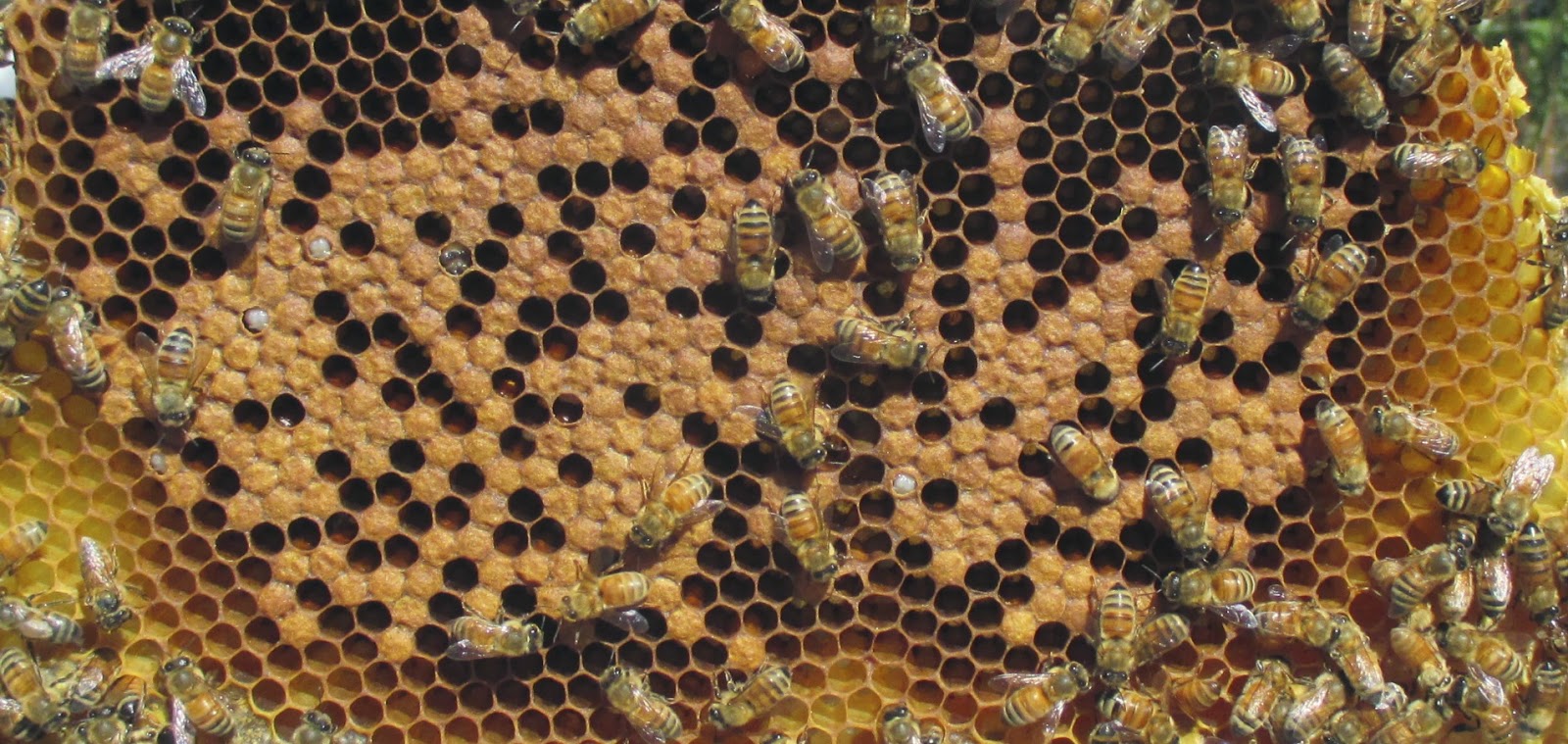
There were no full combs of capped honey as of this date.  A few are a third to half full. Others have a mix of capped honey on top, and partial brood below. All of the capped brood cells are worker cells. Charles and I looked at every comb. We saw one lone drone in the whole hive. The boys have been kicked out, as the workers are preparing to over-winter. We did notice that a few of the capped worker cells had their covers torn off, exposing the developing pupae inside.

The queen is still there and she is laying eggs.  We saw cells with eggs as well as others with  developing larvae. Pollen stores are low, and this could be a concern over time.

Charles also pointed out that our hive has been visited by the Varroa Destructor mite, and that they have taken up residence in the hive. The varroa is like a tick. It sucks the blood out of adult bees, and can also be found in the cells of developing larvae. The varroa carries viruses with it. With their immune systems weakened, bees then succumb to these viruses.

Deformed Wing Virus is one of the viruses that is be transmitted by the mite. Honey bees with DWV have shriveled and deformed wings. I've observed six or seven bees with this condition. Charles also pointed out two adult worker bees that were carrying varroa mites on their backs. He also pointed out two or three worker bees whose coloring was paler than the rest. "These are sick bees", he said.

This could be a problem over time. Charles' comment to me was, "All hives have varroa. Your's doesn't look that bad. It's a little weak and your bees could store more pollen. We'll check how things are in two or three weeks. You may have to feed them over the winter."

Workers in a hygienic hive will get rid of the diseased pupae and bees with DWV. There were 10 discarded pupae on my landing board this morning, along with the bodies of nine or ten workers. I saw the same thing yesterday. Ants are having a field day on the dead and dying.

Here are a few pics of our hive. I planned to take pictures of each bar, but my battery died after I was a little more than half through.
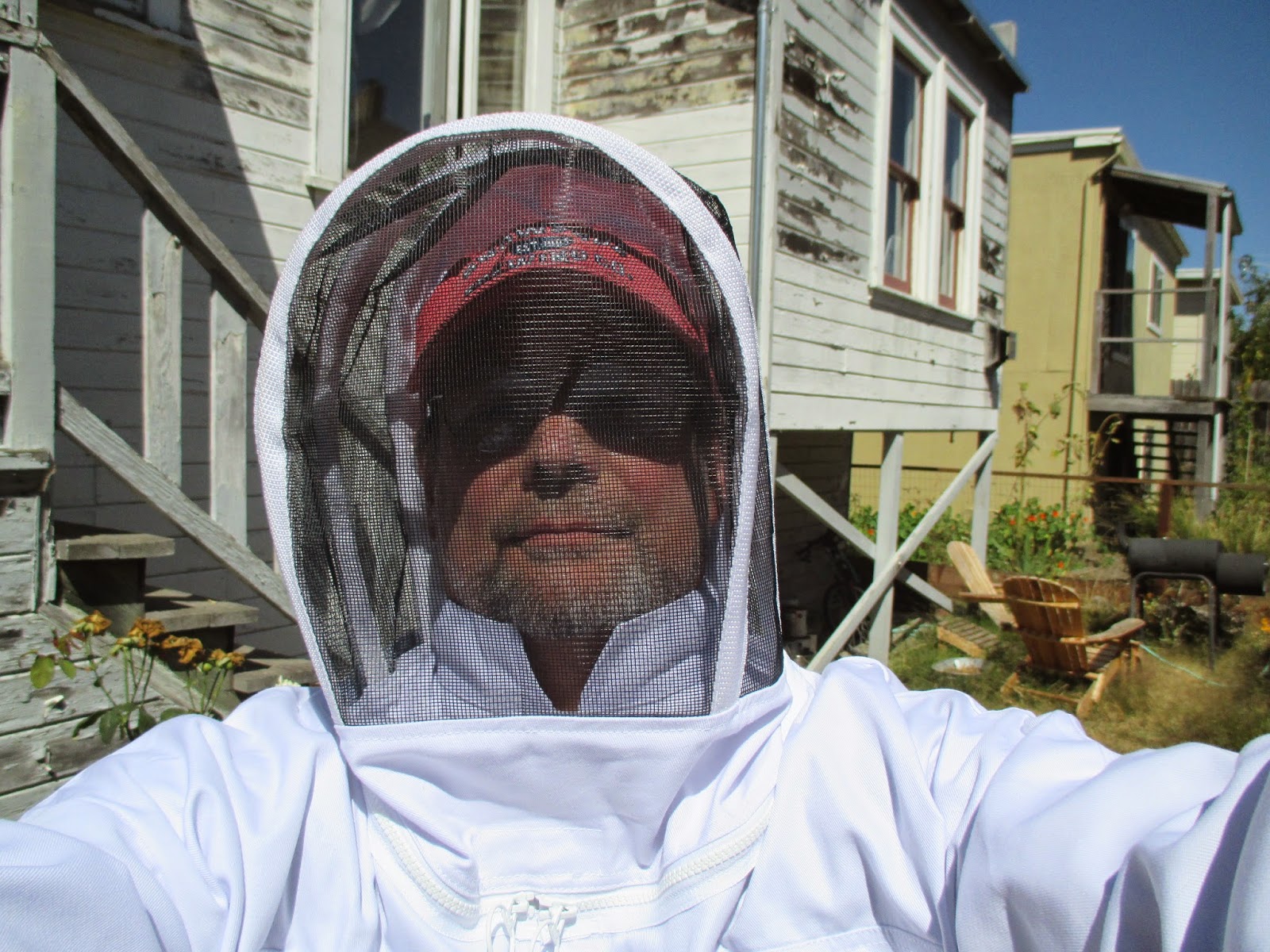
Your's truly

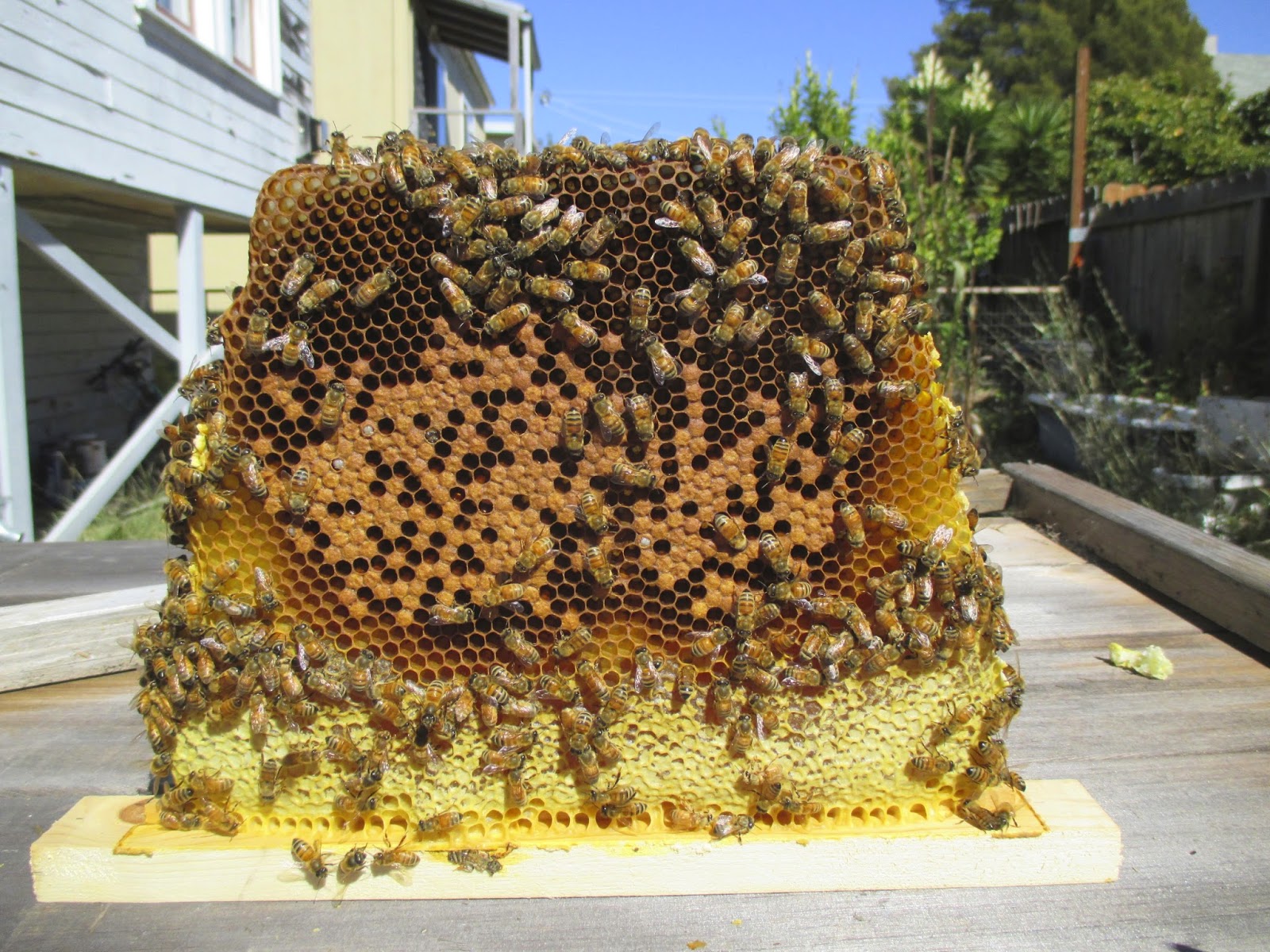
Worker brood in the center, with capped honey.

Worker brood in the center with some capped honey.

Capped Worker Cells with some torn covers.

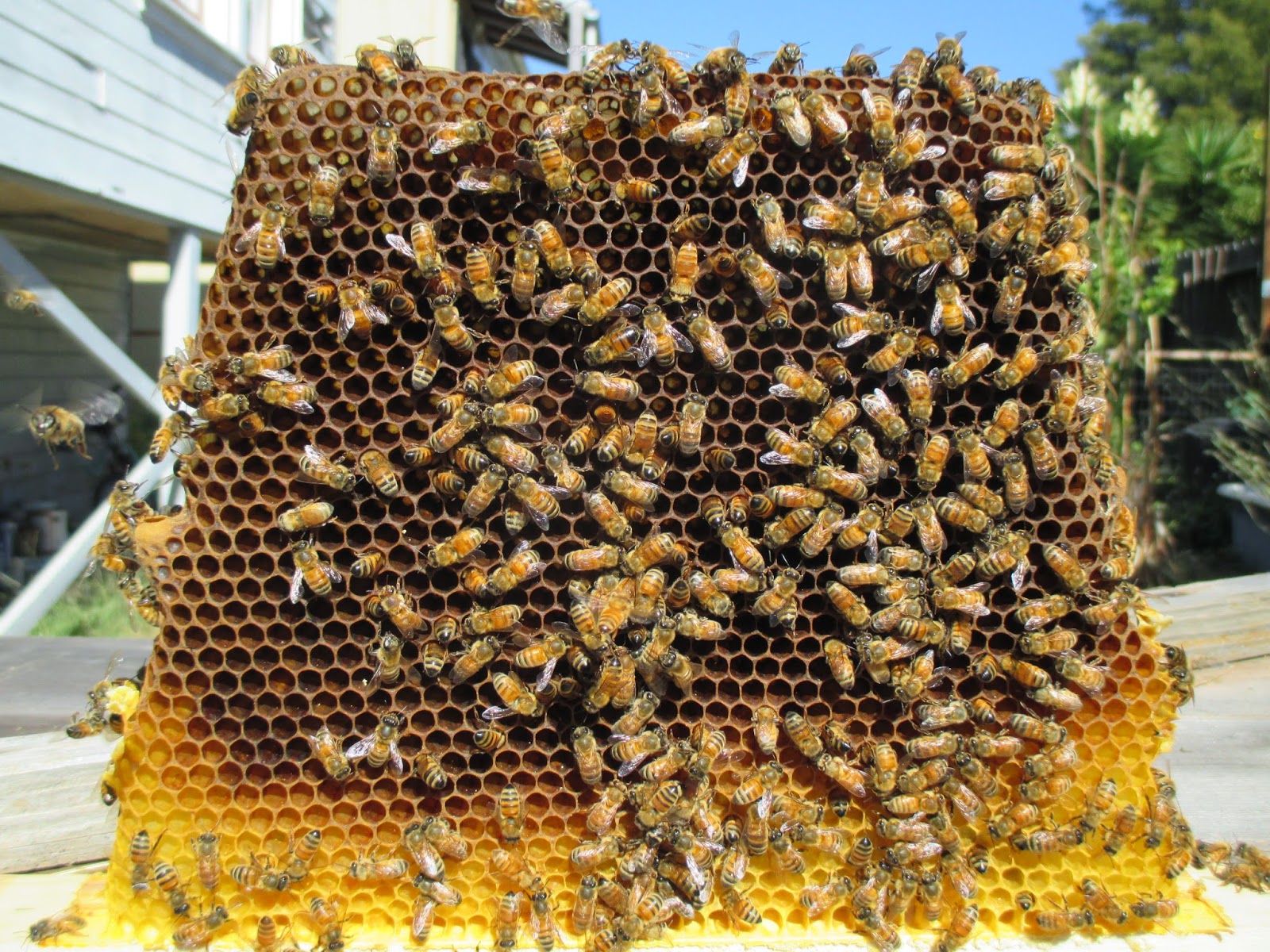
This is comb that was used for Drone cells. The cells are larger than worker cells. Notice that they are all empty. The drones were expelled. We put this toward the back of the hive, as the queen will not lay worker eggs in drone cells

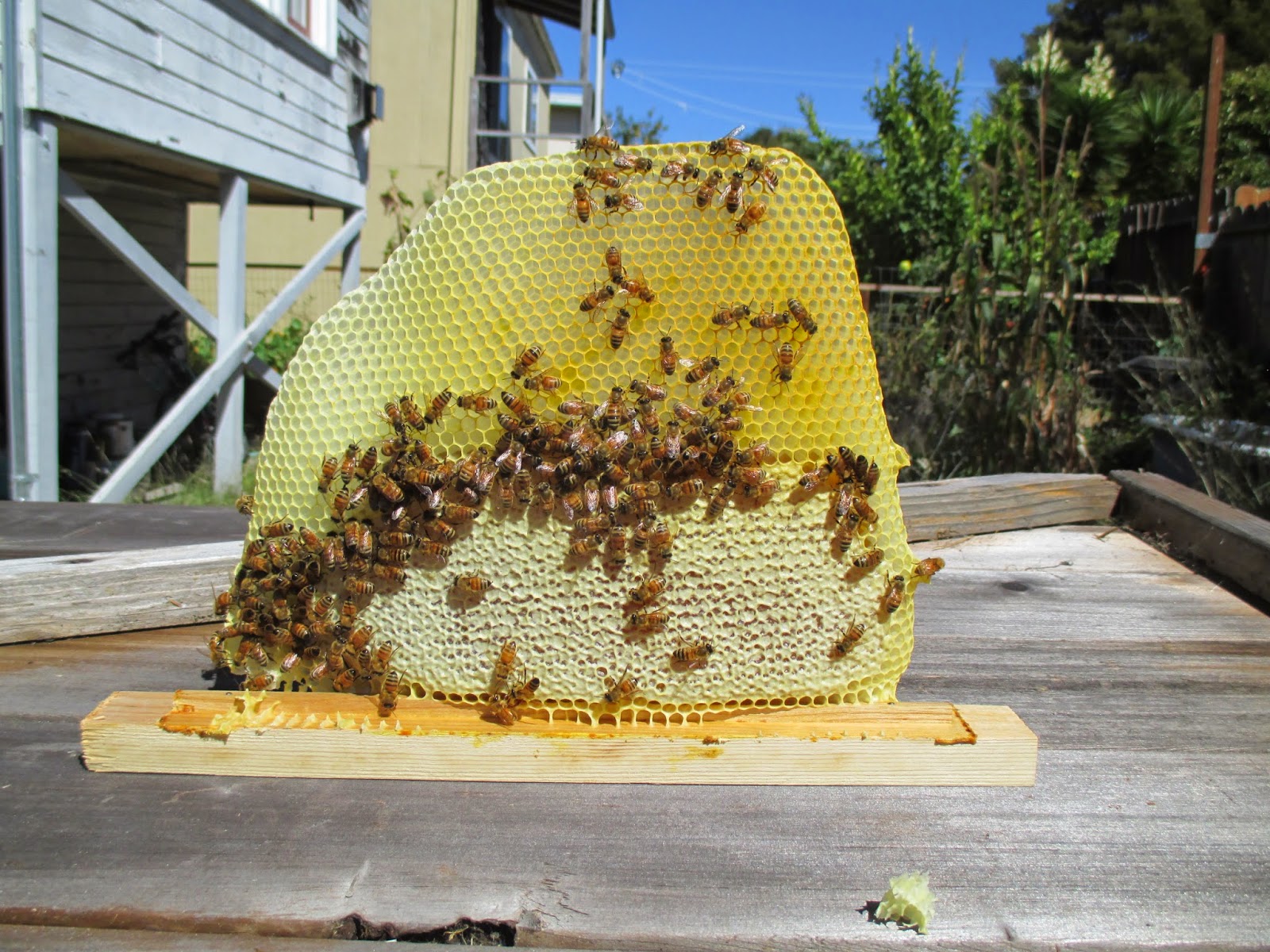
This was towards the back. It has only been used to store honey.

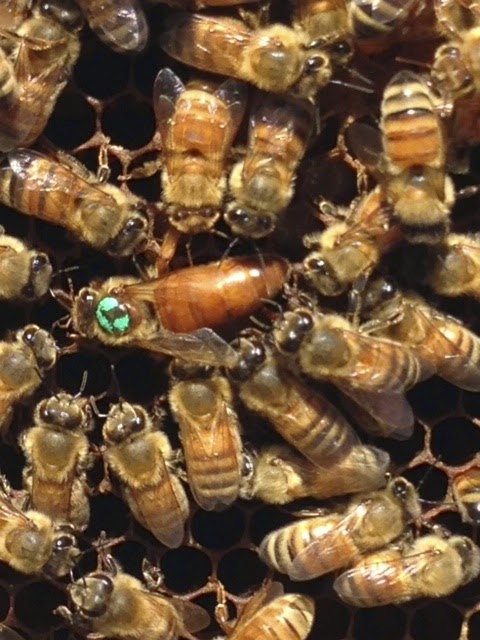
The queen bee (with green dot for identification purposes)

Honey bee with Deformed Wing Virus, thanks to Varroa Destructor.
Note the shriveled wings.

Another view


   And the bead goes on …….

Sunday, August 24, 2014

Drop in population.

It's been almost a month since I've posted anything here. I've had company visiting from the East Coast, and have also been busy getting ready for the new school year (I am a teacher).

We are still in the middle of a drought of historic proportions here in California. I am still observing foragers returning with pollen, but there seems that there are fewer bees. I've sat and watched for drones returning from their congregations in the afternoon and have seen far fewer of them. I believe that most of them have been expelled.

I haven't done a hive inspection for awhile. I've noticed three things:

1. Workers have been building more comb

2. There are fewer bees

3. They seem slower

Here are a couple of pictures showing what I mean.


This shot is taken at the far end of the hive. The exposed come to the right used to be covered with bees. I thought that this meant that we were in a nectar flow and that bees were out foraging. If that were true, these would be covered with bees at night. Not so.


Here is a view including comb covered by workers. I think I need to inspect the hive and see what's going on inside. Maybe over Labor Day weekend.

Saturday, July 26, 2014

Honeybee created air conditioning.

Bee bearding is a hive phenomena that is often observed during the warmer summer months. The temperature inside the hive around the brood nest needs to be kept between 92 and 95 degrees Fahrenheit.  This is accomplished during the hot summer months in a most ingenious way.

Workers that would normally contribute their body’s warmth to the brood area in order to help maintain ideal temperature during cooler periods leave the hive and hang around on the outside. Foraging bees bring in water droplets and deposit then around the inside of the hive. Other workers inside and outside the hive create airflow by fanning their wings. This airflow causes the water droplets to evaporate, thereby cooling the hive. Voila – bee created air conditioning! This is simply amazing.


It has been hot for us the past few days. Ambient temperatures have been around 82 to 85 degrees. It's been warmer in the hive. Here is a short video of bee bearding on our hive. There are bees hanging around on the side panel. Many of the bees on the landing board are fanning their wings in order to help create airflow.


Friday, July 25, 2014

Drought and Drone Expulsion


It is late July and we here in California have been in the midst of a severe drought. It is so severe that the State has said that anyone hosing down their driveway to keep it clean, using their hose for any purpose without a nozzle that can turn the flow off, and other wasteful water practices are liable to a $500 fine. Local parks are not watering their grounds and have posted signs that read "Brown is the new green." With less watering of gardens and parks in municipal areas, there must be a lack of forage.

I have wondered how this has been affecting the bees in our hive. They still go out and forage everyday, but their building of comb has slowed way done. They also seem to be a bit mean.

We came back from 10 days of vacation on Monday. I checked the hive out on Tuesday and noticed a few drones on the ground in front of the landing board. No workers, just six or seven drones. They couldn't fly and were being attacked by ants. I rescued one, cleaned him off, and put him on the landing board where he was immediately attacked and thrown to the ground. I went out and checked the hive later that night and noticed 5 pupae that had been removed from their cells and were discarded as well.

All of this points to the probability that their is not enough stores in the hive to support all it's members. Drones are being unceremoniously expelled from the hive for it's survival. All drones do is eat and try to mate with virgin queens. They are being dumped as they do not collect nectar or pollen, or provide any other useful task for the hive.

Here is a YouTube link to a video of what I've observed. The file was to large to post here.The first part highlights the orientation flights of young honeybees.

www.youtube.com/watch?v=_DBo1DzLgDg


Monday, July 7, 2014

Something new

The door bell rang yesterday afternoon. It was my neighbor, Carol. “Rich, I think there’s something wrong with your bees”, she said. “There’s a big cloud of them  flying all around the hive, more than I ever saw before. It doesn’t look normal. Maybe something bothered them? Maybe a raccoon?”

I went out to check on the hive, and sure enough, Carol was right. I thought they might be getting ready to swarm. A swarm is when half of the bees and the queen leave to establish a new hive. Bees do this when there is no more room in the hive for more bees.

Or, maybe a summer swarm from another hive was trying take over this one.  Maybe, just maybe, I had a huge aerial bee battle going on. Sort of like a bee version of ‘the Battle of Britain’. I got on my knees to see if there were any dead or dying bees on the ground in front of the hive. I checked the landing board to see if there were any bees locked in mortal combat. Nope. Nada. What I had was a heck of a lot of bees flying all around the front of the hive. I did next what any self respecting junior bee keeper would do. I turned to Google.

I found out that what I was observing was the orientation flight of three-week old bees. Workers do not fly right after leaving their wax cells. They spend about three week doing jobs inside the hive. Then, like clock work, they take their first foray into the world outside the hive. They fly around in greater and greater circles, facing the hive to get their bearings. They will remember this when they go out to forage for nectar and pollen. How else would they know how to get home?


A single orientation flight generally lasts less than 5 minutes, and successive flights appear to increase in duration and distance from the colony. Remarkably, the stem length of certain brain interneurons shorten during the first flight, perhaps preparing the worker's nervous system to record and remember orientation stimuli...


There we go, orientation flights! Just another interesting fact from the world of the honeybee. Here is link to a video I tried to include here. It wouldn't post. The video below the link is one that did post. Happy viewing.


Orientation Flight


I gotta clear out that stuff in the back corner of my backyard! :-)


Saturday, June 28, 2014

A closer inspection.

It looked like the bees in our hive had completed or were building comb throughout the hive. This seemed to be confirmed by looking through the observation window. As nectar flow begins earlier in California, we decided to check to see if there was any honeycomb ready to harvest.

This is a picture of Ryan starting our hive check. He is carefully prying the top bar away from from the one next to it.


Here's a picture of  me performing the  same task.


We needed to cut the brace comb that was attaching the comb to the sides of the hive. You can see the knife cutting comb here.


Just a fun picture of me holding the knife.


Ryan is holding one of the combs that we inspected. There is capped honey cells in the top third of the comb. The rest is brood comb where the queen had laid some eggs. This comb had a combination of honey cells, worker bee cells, and drone cells. The honey cells are capped with a whitish wax. The brood cells are capped with an orangish wax and pollen combination cover. The drones cells are slightly larger and have a domed cap.


Here is a better view with the comb resting on the top bar. It is upside down.


This is  a close up of the section that was predominantly drone cells. Practically all of the bees in this picture are drones that have recently come our of their cells.


There weren't any comb that were completely filled with capped honey. We found one that we thought was just honey at the top with no brood on the bottom. We harvested this comb and got about one half of a cup of honey. It was thick, light colored, and tasted great. We cut off the bottom of the empty comb and I saved it to show my next year's kindergarten class.


Much to our surprise, the queen had laid eggs in this comb, too. I noticed developing larva three days later. The eggs were so small that we did not see them. Some of the larva had died and had turned black.


What we learned:
  1. We did not notice any Chalkbrood 'mummies'. 
  2. Our hive is healthy.
  3. The queen is still busy laying eggs to build up the hive's population.
  4. It has a healthy number of drones.
  5. We do not have any surplus honey to harvest, yet.

Please post a comment, if you are reading this. I'm wondering how many 'bots' and how many people are reading these posts. 

Thanks for your comments.


Friday, June 20, 2014

In Honor of Drones

Drones. Male honeybees. Big Fat Drone Boys …. All they do is eat, hang around with other drones, and wait for a virgin queen to fly by. When a queen does fly by several will copulate with her in mid-flight, dying in the process. Sometime in the Autumn after the nectar flows have ended, their sisters unceremoniously dump them from the hive. They have their wings chewed off and are dumped kicked out again if they try and return. All of this is done for the good of the hive as the workers prepare to over winter. At this time of year drones are nothing more than extra mouths to feed. To paraphrase Ebenezer Scrooge, they are expelled in order to “decrease the surplus population”.


Yet the hive would not survive without them. Without drones, queens would only lay unfertilized eggs which would develop into, well, drones. And then the hive would die. Drones (from eight to twenty drones per queen) inseminate virgin queens while in flight. Once inseminated, queens are then able to lay eggs that will develop into undeveloped females (workers), queens, and drones. There would be no hive without drones, no pollination, and no honey. Here is a video I put together with pictures of drones from my hive. The music is from the movie The Eagle, and is titled I Will Return and was composed by Atli Örvarsson.