Here is a video clip of an unwanted worker bee being 'mugged' by members of the hive. It's a little blurry, but gets the point across.
Friday, June 6, 2014
Rumble In The Hive
As previously posted, one of the jobs of worker bees is to guard the hive and to keep intruders out. The queen bee in a hive gives off a distinct pheromone that workers and drones carry. This pheromone is the identifying characteristic for a particular hive. Honeybees from other hives (Particularly workers. Drones seem to get a pass.) yellow jackets, wasps, and other creatures not carrying the pheromone need to look out.
Here is a video clip of an unwanted worker bee being 'mugged' by members of the hive. It's a little blurry, but gets the point across.
Here is a video clip of an unwanted worker bee being 'mugged' by members of the hive. It's a little blurry, but gets the point across.

Sunday, June 1, 2014
Checking comb in a Top Bar hive.
Our bees have been pretty busy building comb despite having been infected with Chalkbrood. Here is a short video of my inspecting a couple of comb about three weeks ago. It was really cool, and I didn't get stung!
My wife Sandra was brave enough to shoot the video. Our bees have build seven more comb since this was taken.
Thursday, May 29, 2014
Bee Photos
The hive seems to be doing fine. I've only seen two or three larvae mummies in the past couple of days. Ryan and I talked about it and decided to increase ventilation by removing a couple of the top bars at the back. We still need to monitor to make sure the hive is on the road to health.
I've been learning more about the different jobs in the life of a worker bee. I've also been able to take some pretty cool photos of worker bees as guard bees. At around 21 days the venom in a bee's stinger is at it's strongest. It is at this stage that workers guard the hive. Guard bees check out each and every bee that enters the hive. They can tell by the bee's odor if the bee belongs to the hive or not. They will sting workers of other hives and any other intruder; be it a wasp, yellow jacket, or mammal - skunk, raccoon, etc. They will defend the hive with their lives. When defending they also give off a pheromone that tells the other bees in the hive that there is an intruder. More and more bees will come and join in the fight and chase the unwanted away.
Here are a few pictures I took of bees guarding the hive.


A guard bee at the right and other workers fanning the hive
to cool it and to help with nectar evaporation.

I've been learning more about the different jobs in the life of a worker bee. I've also been able to take some pretty cool photos of worker bees as guard bees. At around 21 days the venom in a bee's stinger is at it's strongest. It is at this stage that workers guard the hive. Guard bees check out each and every bee that enters the hive. They can tell by the bee's odor if the bee belongs to the hive or not. They will sting workers of other hives and any other intruder; be it a wasp, yellow jacket, or mammal - skunk, raccoon, etc. They will defend the hive with their lives. When defending they also give off a pheromone that tells the other bees in the hive that there is an intruder. More and more bees will come and join in the fight and chase the unwanted away.
Here are a few pictures I took of bees guarding the hive.
Workers daring strangers to enter the hive.
Close up
Like offensive linemen protecting
the pocket for a quarterback .
to cool it and to help with nectar evaporation.
Just a close up that I like.
Monday, May 26, 2014
First Challenge
I'm one of those beekeepers who likes to go outside and 'hangout' with his hive. I usually go out with a cup of coffee and maybe my laptop and sit in my beach chair close to the hive entry. I find this quite relaxing, sort of like watching fish in a fish tank.
I was hanging out with the girls a couple of days ago when I noticed a dead bee and what seemed to be bee body parts on the landing board. I didn't think much of this as I've learned a bit about the life cycle of bees and knew that some of our bees were at the end of their lives. As bees are tidy creatures, the dead and the dying are carried out of the hive by workers and are disposed of.


I was hanging out with the girls a couple of days ago when I noticed a dead bee and what seemed to be bee body parts on the landing board. I didn't think much of this as I've learned a bit about the life cycle of bees and knew that some of our bees were at the end of their lives. As bees are tidy creatures, the dead and the dying are carried out of the hive by workers and are disposed of.
The bone yard.
Note the chalky white and gray/black pieces on the landing board. I noticed more of these the next day and decided to search the internet for more information. It seems our hive is infected with something called Chalkbrood. Chalkbrood is caused by the fungus Ascosphaera Apis. This fungus is thought to be introduced to the hive either by pollen carrying the spores or by robber bees. It attacks the developing larvae within the first three days of their development and usually kills them after two days, turning them into white or gray/black chalky mummies. Hives are most susceptible to chalk brood in the Spring when they are building their population up to full strength. It may also be linked to excess moisture in the hive. There is no cure for this and most hives recover on their own. Proper hive ventilation is key. Hives that do not recover on their own often recover after replacing the queen with a more hygienic one. Naturally, this condition can weaken a hive and affect it's honey production. We are in a 'wait and see' mode, as we have just noticed this condition.
Saturday, May 24, 2014
Moving the false back.
Our bees adjusted pretty quickly to their new home. The workers congregated as a massive 'bee ball' around the queen at the back of the hive. After a couple of days we moved the moveable false back partition towards the middle of the hive. The bees were already building comb. The idea is to have the bees establish their brood comb, pollen and initial honey stores in the front half of the hive. The false back will be moved to the rear when the front half of the hive is full of comb. This will then allow the bees to use the back of the hive for excess honey stores.
You can see that we've moved the false back mid way in these two videos.
You can see that we've moved the false back mid way in these two videos.
Master Teacher
Hive established after moving the false back.
Friday, May 23, 2014
Getting Started
I was introduced to the world of bee keeping by my friend
and tenant, Ryan. Ryan works as a post-doc at and has a Ph. D. in Physics. It was while working on his Ph. D. that Ryan was introduced to Corwin Bell of Backyard Hive and his
promotion of using the Kenyan Top Bar hive. You can check out Backyard Hive at
their web site: http://www.backyardhive.com.
Ryan and I had talked about having a hive a year ago but
waited to long to get started. We built our hive in late March of this year and
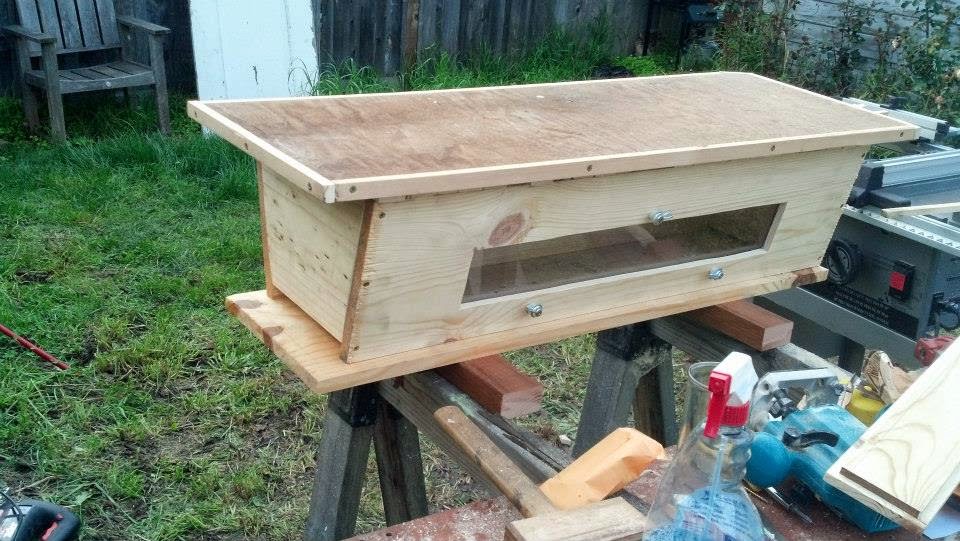
established our hive one rainy evening in April. Why a Top Bar hive instead of the more traditional Langstroth? A Top Bar hive is designed to be more bee friendly, and by design allows bees to build comb in a more natural fashion. It also allows the queen to roam through the hive instead of using a separator. It's horizontal design is a back saver as it does not require heavy lifting when inspecting the health of the hive. Here are a few pictures of us working on it.
 |
| Ryan |
 |
| Rich |
 |
| View 1 |
 |
| View 2 |
In early April Ryan went to pick up our bees over at the Bee Healthy Honey Shop on Telegraph Avenue, here in Oakland. You can check out their site here: http://beehealthyhoneyshop.com.
We established the bees that night. I went out to check on them the next day after work and took this short video. I showed it to my class (I teach kindergarten) the next day and they loved it. Particularly the part when I said, "Yes, boys and girls, we have bees." They thought I was referring specifically to them!
I'll be posting more as I learn more about this fascinating world.
Subscribe to:
Posts (Atom)